

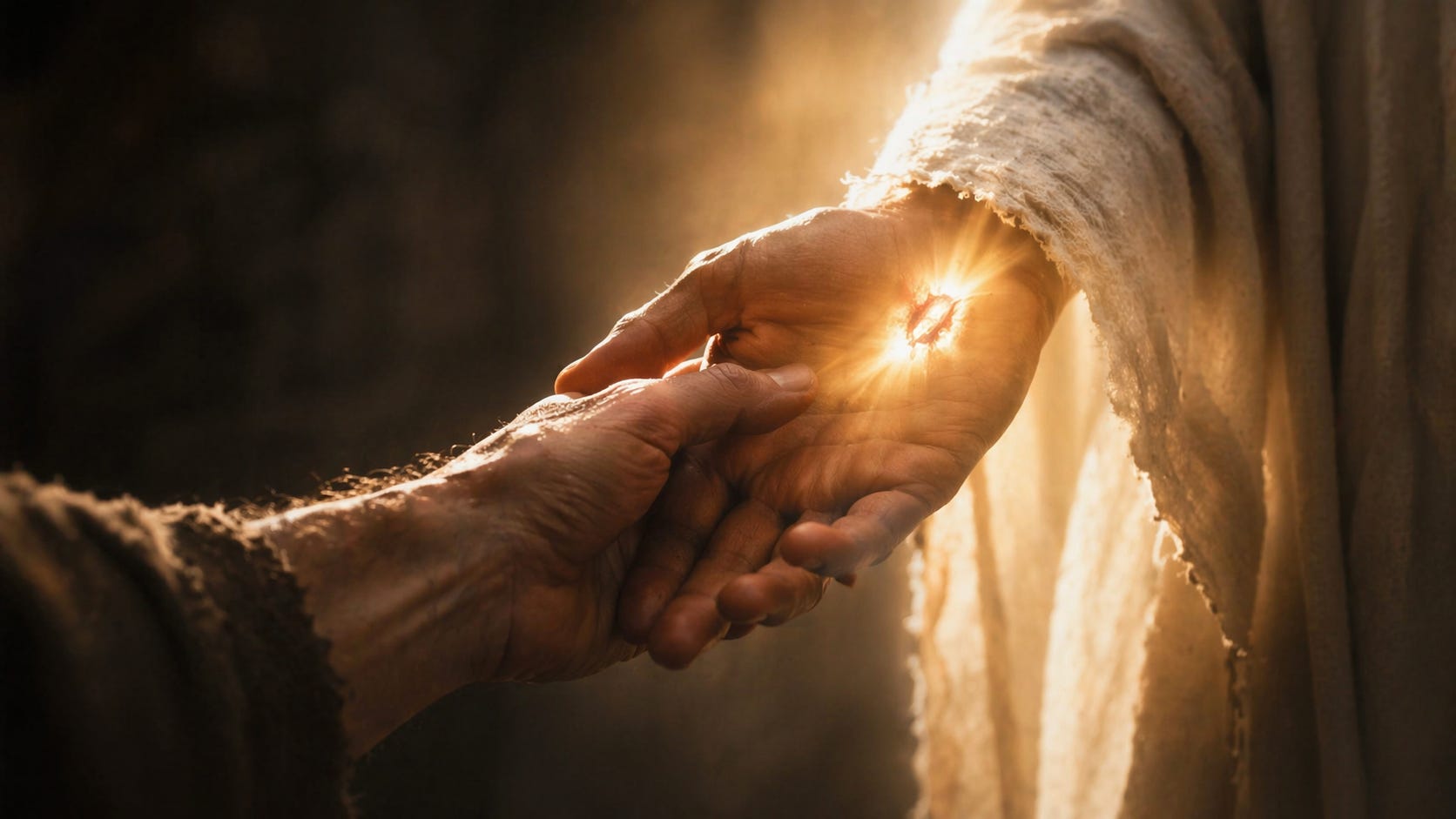
It’s been eight days- now JESUS comes to His frightened disciples, again.
He does not wait for them to become brave;
   …for them to become worthy;
   …for them to conquer their shame,
to untangle their thoughts or prove the quality of their faith.He comes while the doors are shut;
while they are still weakened by fear;
while the wounds of Good Friday are still fresh in their memory.
And when He comes, He does not leave His Cross behind.He appears in His risen glory, yes—but still bearing the marks: The Hands. The side. The wounds are not erased by the Resurrection: They are transfigured; They shine now as everlasting witnesses of victory. Christ is risen, but He is risen as the Lamb-once-slain.
The Resurrection does not cancel the Cross.
It reveals what the Cross truly was:
   not failure, but triumph;
   not the end of hope for the Kingdom, but its public validation that it is here.
That is why St. Thomas’s request must be handled with reverence.Thomas- or more regularly, “(the) Doubting Thomas.”
John, his fellow disciple, does not name him that way;
this dubious nickname came later,
as though the Church had been given leave to sneer at a holy apostle.
And why?
Because Thomas says that he desires to see the Body of Jesus,
and specifically the marks of his salvation.
Thomas is not asking for something to deserve
a label from the category of unfaithfulness.
He is asking for Christ Himself—the real Christ, the crucified and risen Christ.Is this not our own cry? Do we not also desire to see the Body with the marks of our forgiveness. Like Thomas, we too find no value in vague spirituality, manufactured religious mood, or hollow sentiments, Authentic reality is JESUS Christ Himself— Christ crucified, Christ risen, Christ among us.
Thomas’s request is not foreign to Christian faith,
   it is the ache of Christian faith weary of the world taking our Joy.
And our LORD does not despise it.
Eight days later, Jesus comes again.
The doors are shut again.
The disciples are gathered again-
   this time Thomas is there;
   he wasn’t there when JESUS visited them the evening of His Resurrection;
   the evening when He commissioned them with the Holy SPIRIT.
There is a character of ‘according to GOD’s will’ about his not being there,
   like the blind man of John 9 who wasn’t blind because of sin-
   he was blind “so that GOD could reveal His works through his blindness.”
We don’t know why he wasn’t there;
   John doesn’t imply it was for a bad reason-
   he just wasn’t present.
(I feel for Thomas, by the way- I don’t know about you
   but this sounds like the kind of thing that would happen to me.)
So Thomas is suffering from a kind of blindness that isn’t his fault:
   he hasn’t seen JESUS, so he is ‘blind’.
You can hear the frustration in his request-
   after all, he is likely still grieving;
   and he wants to see what his fellow Eleven saw!-
JESUS showed them the marks that evening:
   Thomas wants to see them too-
   he won’t settle for being a second-hand disciple.
This is what is behind his, “Unless I see…I will not believe.”
JESUS, in great mercy, addresses Thomas directly;
   He offers him exactly what Thomas longed for-
   and then gives him an honor the others did not receive:
“Reach out thy finger... reach out thy hand…
   Touch the marks… embrace them…”
Our LORD is not humiliated by being examined:
   He is glorified in it.
His wounds are His royal insignia;
   the marks of death have become the seals of life everlasting.